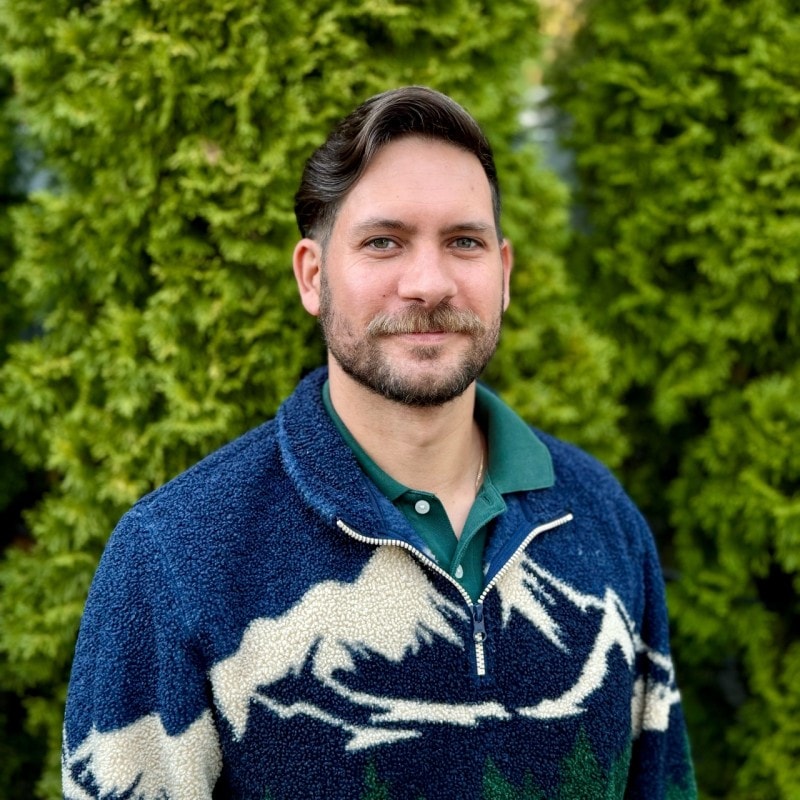
At every major turning point in James Gunselman's career, there was someone in his corner. A mentor who saw something in him before he saw it in himself.
A 2015 Biotechnology and Genomics graduate of the Rutgers Master of Business and Science (MBS) degree program with a sub-concentration in Bioinformatics, James Gunselman started his career as a self-described "mad scientist" in an early discovery chemistry lab at Bristol Myers Squibb, and worked his way through R&D, sustainability strategy, patient safety, and pharmacovigilance before landing his current role as U.S. Commercial Strategy and Operations Senior Project Manager at Ascendis Pharma, a global biopharmaceutical company advancing programs in Endocrinology Rare Disease and Oncology.
Earlier this year, he launched The Q-Suite alongside Ken Kundis. The podcast gives listeners access to the perspectives and experiences of LGBTQ+ executives while offering lessons about leadership, career development, and workplace culture that can benefit anyone.
We caught up with Gunselman to hear about his professional journey, his experience as a Master of Business and Science degree student, and how it helped him shape his career.
How did you first find out about the MBS degree, and why did you decide to apply?
Gunselman’s path towards the MBS degree was not straightforward. He learned about it during a pivotal conversation with a trusted mentor. After graduating pre-med from Rutgers Newark and accepting admission to medical school, Gunselman had a change of heart the summer before he was set to begin. He reached out to a student advisor at Rutgers who had supported him throughout undergrad, who recommended the Master of Business and Science degree.
Gunselman credits that mentor entirely for setting him on his path.
"At each stage of my career, I had a mentor that helped me make a big decision,” said Gunselman, “whether it was taking a job, pivoting out of med school, or figuring out what my next education looks like. Mentorship has been such a big part of my life."
Within the Professional Science Master’s program, he gives particular credit to Kathleen Cashman Walter, Abbe Rosenthal, and Dr. Paul Meers.
Your career has spanned both business and science. How did the MBS degree program lay that foundation?
"I accredit the Master of Business and Science degree with a lot of the discipline and the drive and the business skills that landed me where I am today," said Gunselman. For him, the lab experience was just as important as the business coursework.
"The opportunity to be in a chemistry lab really set me up for success. If you understand the science, you can do business," said Gunselman.
He credits several courses that have been particularly beneficial.
"If you're an introvert, it puts you through the wringer, but it's all about practice." He still uses the leadership principles and presentation skills from that course in his current work.
“As someone who is very structured in their work, it was nice to see the correlation between science and how you can move a project structurally. Because that’s what a lab experiment is,” said Gunselman. Additionally, he now works as a project manager.
"You run into these ethical dilemmas sometimes at work. You have to focus on the patient so much. That class really does prepare you for those ethical questions you may run into while operating in a life science company," he said.
- A database course, which was part of his bioinformatics sub-concentration.
"I still use it sometimes today,” said Gunselman, “especially when talking with IT people."
Were there any experiences that had a particularly lasting impact?
Gunselman’s mid-program thesis turned out to have an unexpected full-circle moment.
"I learned about a carrier system for delivering acetaminophen with less liver damage, and that is something we use in my current company all the time," said Gunselman. “That's my full circle. It's so interesting that I learned about it in school, and now I work at a company that actually uses it.”
Let's talk about The Q-Suite. What inspired you and your co-host, Ken Kundis, to launch it together?
"Mentorship can be a little bit awkward to initiate or engage with, especially with a leader or a mentor that you may not have any experience with in the industry that you're seeking them in."
That gap is what drove Gunselman and his co-host Kundis to create the podcast.
"We wanted to create a safe space, not only for the LGBTQ+ community, but also our allies and listeners in general to hear real conversations from executives and their lessons learned throughout their time as leaders," said Gunselman.
He points out that representation matters.
"Particularly in the LGBTQ+ community, there aren't many of us who are executives. To hear from executives who have dealt with—let's call it the rainbow ceiling—is something applicable to really anyone," said Gunselman.
Is there an episode you'd recommend for students?
Episode 3, with Paul D'Souza, Senior Vice President of Global HR at Ulta Beauty.
"That episode is centrally focused around imposter syndrome. Hearing from such a high-level person saying he still experiences imposter syndrome—I think it's good for students to hear that it is something everyone experiences, and that it is just something we have to manage."
You've also talked about the value of passion projects and volunteer work. Why does that matter?
"Passion projects, for me, have always not only fulfilled my purpose in life, but also it's a great way to develop skills," said Gunselman.
He volunteered with the Trevor Project for nearly a decade, taking on marketing, social media, and design work far outside his field at the time.
"You don't know who you could be volunteering with," he said, noting that a Trevor Project connection later led to a referral at Bristol Myers Squibb. "It's always good to build your network in any capacity. One, it fulfils my purpose; two, it helps me build skills; and three, it helps build that network."
Any final words for current MBS students?
"I hope students are finding their people in the program," said Gunselman.
In the MBS degree program, Gunselman found a close group of about five people who studied together, pushed each other, and stayed connected long after graduation. He even credits a fellow MBS student, Nisha Patel, for referring him to his first internship at Bristol Myers Squibb.
"These are people that you will follow and keep in touch with for the rest of your life, and really, those are your peer mentors," said Gunselman. "I've talked extensively about mentorship from leaders, but peer mentorship is, if not equally, important. So, find your people."
You can find The Q-Suite on Spotify, Apple Podcasts, and YouTube.