As part of the “Market Assessment and Analysis” course, taught by Professor Mark Burgess, students often engage with industry leaders who bring real-world perspectives into the classroom through guest speaker sessions. These are intentionally integrated into the curriculum to help students understand how marketing principles are applied within different sectors and consumer products.
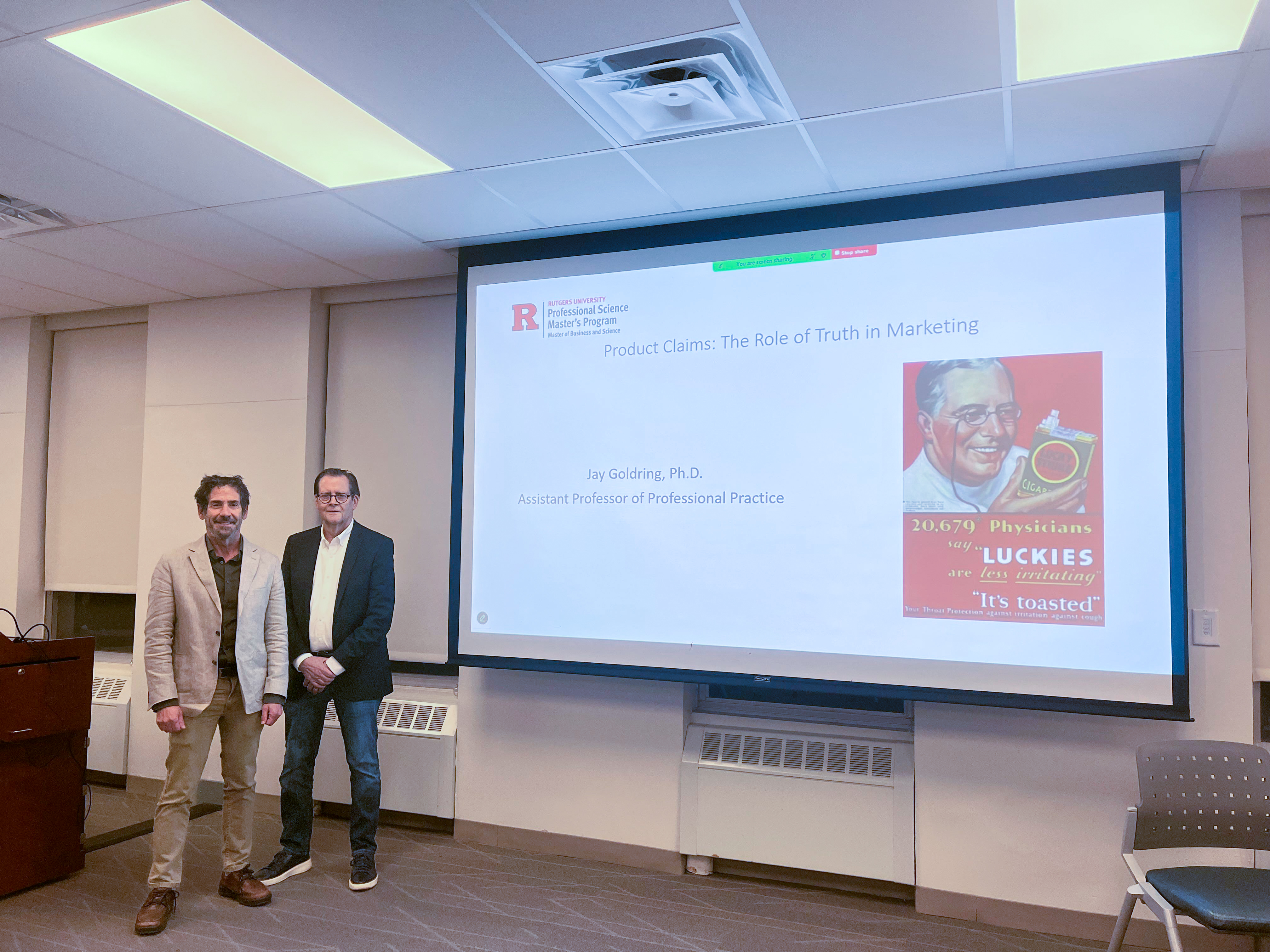
On November 14th, Professor Burgess welcomed Dr. Jay Goldring, who holds extensive experience in regulatory affairs and life science product development, to speak about one of the most important topics in consumer health and wellness marketing: Product Claims and the Role of Truth in Marketing.
Goldring brings decades of multidisciplinary expertise to the life sciences field. His background includes 40 years of experience in quality, safety, and regulatory compliance. 30 years in product development, marketing, and manufacturing of consumer products. Experience working with major companies such as Colgate, Avon, L’Oréal, Wyeth, and Supergoop.
Goldring currently serves as an Instructor and Life Science Advisor for the Professional Science Master’s (PSM) program at Rutgers. You can read more about Goldring on our blog.
Here are some key takeaways from his discussion.
What Are Product Claims?
Product claims are defined as statements made by a manufacturer or seller about a product’s characteristics, benefits, or quality. These claims are often made by companies to boost sales and market their products in a strategic way. Competitors can challenge or oppose the claims, and if so, the company must provide evidentiary support to sustain the claim; otherwise, they can be sued.
“Claims are major sales drivers, as they shape consumer expectations,” said Goldring.
For this reason, claims must be truthful, not misleading, and supported by appropriate evidence.
The Federal Trade Commission (FTC) is the Primary Authority
The FTC was established under the Federal Trade Commission Act and enforces the “truthful and not misleading” standard. In addition, they provide guidelines for some claim categories, including sustainability and green claims, endorsements, and testimonials. These guidelines help ensure that companies are transparent about the benefits of their products.
FTC judges claims under two standards:
- Objective/Verifiable Claims. These claims must be backed by data, evidence, or testing. (Example: “#1 selling sugarless gum.”). These must be substantiated with objective data.
- Non-verifiable Claims. These are opinion-based and not meant to be proven. (Example: “Better ingredients, better pizza.”) However, they must not be misleading.
Food & Drug Administration (FDA)
The FDA reviews health-related product claims for FDA-regulated products, including food, drugs, and cosmetics. FDA specifically authorizes health claims on food including “Calcium and Vitamin D help prevent osteoporosis” and “Soluble fibers may reduce the risk of coronary heart disease.” All such claims must be supported by scientific evidence before they are approved.
Cosmetic product claims such as “long-lasting lipstick” require testing and verification. Endorsements and testimonials from consumers also aid in building a claim, but they must be honest, accurate, and reflect real consumer experience. Companies should avoid making drug or health claims, such as “reduces cellulite,” without sufficient evidence and proper approval, as doing so can lead to regulatory violations.
Attributes of Successful Product Claims
Effective product claims are those that are clear and precise, supported by evidence, relevant to consumer needs, authentic and transparent, and unique and innovative. These characteristics enable companies to differentiate their products in competitive markets while maintaining compliance.
Interactive Learning
Goldring conducted an in-class quiz where students reviewed sample product claims and identified whether they were compliant or non-compliant. This activity encouraged critical thinking around legal, ethical, and strategic considerations in marketing and helped students apply regulatory concepts to real-world examples.
Goldring concluded the session by taking questions from the audience, allowing students to dive deeper into regulation, branding, and how claims affect marketing.
A special thanks to Jay Goldring for sharing his expertise and highlighting the importance of truth, responsibility, and compliance in marketing. His insights reinforced the core message of the Market Assessment course: that effective marketing requires both strategic thinking and a strong grounding in regulatory understanding.
To learn more about upcoming Master of Business and Science events, visit our Events page or follow us on LinkedIn, X (Twitter), Facebook, and Instagram.